

Could Cameroon benefit from a new dynamic of cooperation in the hydrocarbons sector? This is one of the prospects raised by the meeting held on 12 November 2026 between Cameroon’s Minister of Water Resources and Energy, Gaston Eloundou Essomba, and a delegation led by Kevin Okyere, head of Ghanaian group Springfield, accompanied by his Cameroonian partner, Cédric Ketchanga.
Beyond the institutional nature of this meeting, the statements made by the two partners following the working session provide insight into the scope of an economic ambition that deserves particular attention. The objective is not merely to strengthen Cameroon’s capacity to secure supplies of petroleum products, but also to address the logistical costs weighing on the import supply chain and, indirectly, on household purchasing power.
At a time when the availability of hydrocarbons remains a strategic issue for African economies, this initiative seeks to capitalize on the complementarity between an international group with substantial logistics infrastructure and partners firmly established in Cameroon’s economic environment.

A PAN-AFRICAN AMBITION, WITH CAMEROON AS A STRATEGIC FOOTHOLD
For Kevin Okyere, Springfield’s presence in Cameroon is part of a clearly defined continental vision. « We are inspired by Africa and focused on the world. But above all, we are Africans, » he said, emphasising his group’s determination to establish a significant presence across the continent.
Cameroon therefore appears to be a strategic hub in this expansion policy. The Ghanaian businessman intends to develop a mutually beneficial relationship with local partners, one that could contribute to strengthening national and regional energy security.
In his argument, Kevin Okyere places hydrocarbons at the heart of the functioning of modern economies. In his view, no nation can genuinely aspire to development without adequate energy resources. As he points out, « Children must be able to go to school, factories must be able to operate, and people must be able to travel from one place to another. All these activities depend, directly or indirectly, on the availability of oil and gas. »
This is the ambition driving the group’s desire to work with Cameroonian partners to prevent supply disruptions. « We are here to work with our partners to ensure that the people of Cameroon never run short of the fuel needed to keep the economy running, improve their living conditions and support their various activities, » he explained.
This statement sums up Springfield’s philosophy: making the availability of petroleum products an instrument for supporting economic activity and development.
CÉDRIC KETCHANGA BANKS ON SPRINGFIELD GROUP’S LOGISTICAL STRENGTH TO REDUCE COSTS
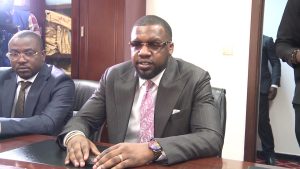
While Kevin Okyere places particular emphasis on energy security, his Cameroonian partner focuses more on the economic and logistical aspects of the project.
For Cédric Ketchanga, the value of this partnership lies particularly in Springfield Group’s ability to mobilise substantial logistical resources, which could reduce cargo transportation costs and ensure the secure delivery of shipments to Cameroon and neighbouring countries.
« Our ambition is to have a positive impact on freight costs and, consequently, on household purchasing power, » he stated.
His reasoning is based on a straightforward economic principle: optimising freight operations to reduce supply costs and, ultimately, enable consumers to benefit from more favourable conditions.
The choice of a partner with a continental reach is therefore no coincidence. Springfield Group, which has developed its activities in West Africa and other African markets, represents, in the eyes of its Cameroonian partner, significant potential in terms of logistical capacity and operational efficiency.
The challenge is to combine the expertise, networks and resources of both groups in order to optimise supply channels. In a sector where transportation costs, delivery times and cargo security have a significant influence on the final price of products, this approach could provide a competitive advantage.
BEYOND OIL: THE BATTLE TO LOWER ENERGY COSTS
Another important dimension of this meeting concerns the prospects for reducing energy costs. The two partners appear determined to place their initiative within a broader reflection on the competitiveness of the Cameroonian economy.
For Cédric Ketchanga, the objective is not simply to facilitate access to petroleum products, but also to contribute to an overall improvement in energy supply conditions.
He therefore expresses the hope that energy costs will eventually decline. If this ambition materialises, it could have significant repercussions on companies’ operating expenses, industrial production costs and, indirectly, the prices borne by households.
Alexandre Mbiam, who is also Managing Director of Bestway Finance Limited and a Cameroonian partner, also refers to the search for finished products and strategic inputs under more competitive conditions, particularly reinforcing steel bars, in line with his activities in the mining sector.
This opening towards other economic sectors suggests a partnership strategy that could extend well beyond the hydrocarbons industry.
CEMAC ALSO IN THE SPOTLIGHT
The ambition being pursued does not stop at Cameroon’s borders. Statements made by the two partners also refer to neighbouring countries in the sub-region.
Cameroon could therefore serve as a launching pad for a broader supply strategy targeting CEMAC markets. This is a particularly interesting prospect given the energy security challenges facing several countries in Central Africa.
Reducing freight costs, securing cargo shipments and optimising logistics channels could, in theory, help improve supply conditions throughout the regional economic community.
The meeting of 12 November 2026 opens up prospects for cooperation whose implications for Cameroon are significant. However, in the petroleum sector, statements of intent must necessarily be followed by verifiable commitments.
For now, Kevin Okyere and Cédric Ketchanga have demonstrated a shared vision: to make their partnership an instrument for securing supplies and improving economic competitiveness.
This meeting builds on the momentum generated by the earlier meeting of 20 October 2026 involving BGN and Zyron Energy.
All that remains is to hope that their words will live up to the promises they hold.